Learning how to read a crochet sweater pattern is the skill that separates crocheters who finish sweaters from those who abandon them halfway through the yoke. Patterns pack a lot of information into a small space, from schematics to stitch repeats to sizing notes, and misreading any one piece can throw off your whole project. This step-by-step guide walks through exactly what to look at, in what order, before you pick up your hook.
Table of Contents
- Start with the Pattern Notes and Schematic
- Confirm the Size You’re Making
- Check Materials and Yarn Substitution Notes
- Understand the Gauge Swatch Instructions
- Decode the Stitch Abbreviations Key
- Learn to Read Repeats and Bracket Notation
- Follow the Construction Order
- Track Your Place with Row Counters or Markers
1. Start with the Pattern Notes and Schematic
Before touching yarn, read the designer’s notes at the top of the pattern in full. This section usually explains construction order, any unusual techHow to Read a Crochet Sweater Pattern: Notes and Schematic First
Before touching yarn, read the designer’s notes at the top of the pattern in full. This section usually explains construction order, any unusual techniques, and finished measurements shown on a schematic diagram with flat garment measurements at bust, length, and sleeve.
The schematic is often more useful than the written size chart alone, since it shows you the actual shape and proportions rather than just circumference numbers.niques, and finished measurements shown on a schematic diagram with flat garment measurements at bust, length, and sleeve.
The schematic is often more useful than the written size chart alone, since it shows you the actual shape and proportions rather than just circumference numbers.
2. Confirm the Size You’re Making
Sizes are usually listed as a range with the pattern written for the smallest size first, followed by larger sizes in parentheses, like S (M, L, XL). Circle or highlight your size throughout the entire pattern before you start, since it’s easy to accidentally follow the wrong number in a parenthetical string later on.
Compare the schematic’s finished bust measurement to your actual chest measurement plus your desired ease, not just your usual clothing size, since crochet sweaters can run differently than knitwear.
3. Check Materials and Yarn Substitution Notes
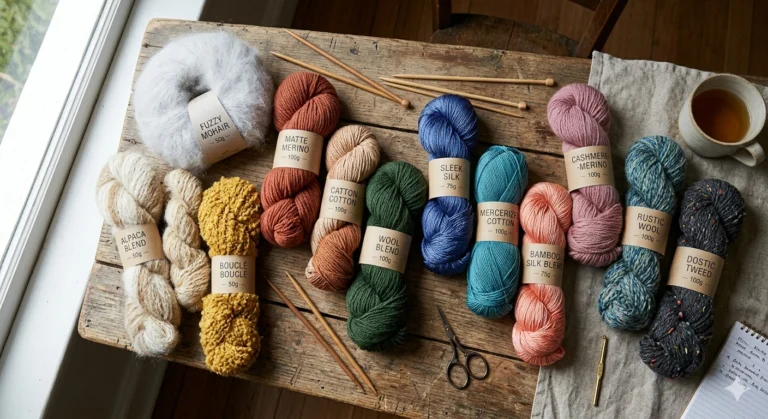
The materials section lists yarn weight, yardage, and the exact hook size the designer used to achieve their gauge. If you’re substituting yarn, match the weight category and yardage first, since two yarns labeled the same weight can still behave differently in stitch definition and drape.
Fiber content matters here too: a wool substitute for a cotton original will behave very differently in terms of stretch, drape, and warmth.
4. Understand the Gauge Swatch Instructions
Gauge is listed as a stitch and row count over a specific measurement, almost always a 4-inch square, worked in the pattern’s main stitch. This number exists so your finished sweater matches the schematic measurements, not just so you can skip ahead.
Work a swatch larger than the stated measurement, block it the way the pattern instructs, then measure the center to avoid distorted edge stitches skewing your count.
5. Decode the Stitch Abbreviations Key
Every pattern includes a key near the beginning listing every abbreviation used: chain (ch), single crochet (sc), half double crochet (hdc), double crochet (dc), treble crochet (tr), and slip stitch (sl st), plus any special stitches unique to that design. Read this key even if you recognize the basic stitches, since designers sometimes define unconventional stitch combinations under a shorthand name.
US and UK terminology differ for the same abbreviations, so confirm which system the pattern uses before you start counting stitches.
6. Learn to Read Repeats and Bracket Notation
Patterns use asterisks, brackets, and parentheses to show repeated stitch sequences without spelling them out row after row. An instruction like “*2 dc, ch 1; repeat from * across” means you work that bracketed sequence continuously to the end of the row.
Numbers directly after a closing bracket, like “[dc, ch 1] x4,” tell you exactly how many times to repeat that sequence, which matters most in patterned stitch rows where miscounting throws off the whole repeat.
7. Follow the Construction Order
Sweater patterns typically specify construction order in the notes: whether you work the body first and sleeves separately, build everything top-down in one piece, or work individual pieces to seam later. This order affects how you interpret shaping instructions, since increases and decreases are written relative to that specific sequence.
Skipping ahead to a later section without understanding the construction order is a common source of confusion, especially in raglan patterns with simultaneous body and sleeve shaping.
8. Track Your Place with Row Counters or Markers
Long sweater patterns often span dozens of rows or rounds with shaping happening at specific intervals, so a row counter or a printed copy with checkmarks prevents losing your place. Stitch markers at shaping points, like raglan increase lines, make it easy to glance down and confirm you’re on track without recounting from the beginning.
This tracking habit matters more in sweater patterns than smaller projects simply because of the sheer number of rows involved before you can meaningfully check your progress against the schematic.
Always keep the full written pattern open as your primary reference; this guide explains how to interpret pattern language, not a substitute for the designer’s specific instructions.
FAQ
What does “work even” mean in a crochet sweater pattern?
It means continue in the established stitch pattern without any increases or decreases until you reach the length or row count specified next.
Why do sweater patterns list sizes in parentheses?
It’s a space-saving format showing multiple sizes in one line, with your size’s numbers appearing in the same position throughout the pattern.
Is it okay to skip the gauge swatch on a sweater?
Not recommended. Sweaters require closer fit than accessories, and a small gauge difference can shift the finished size by several inches.
Conclusion
Once you know how to read a crochet sweater pattern properly, schematics, repeats, and construction notes stop feeling like a foreign language and start reading like a clear roadmap. Save this guide for your next pattern purchase, and revisit it anytime a new abbreviation trips you up. A little patience with the pattern page now saves hours of frogging later.